
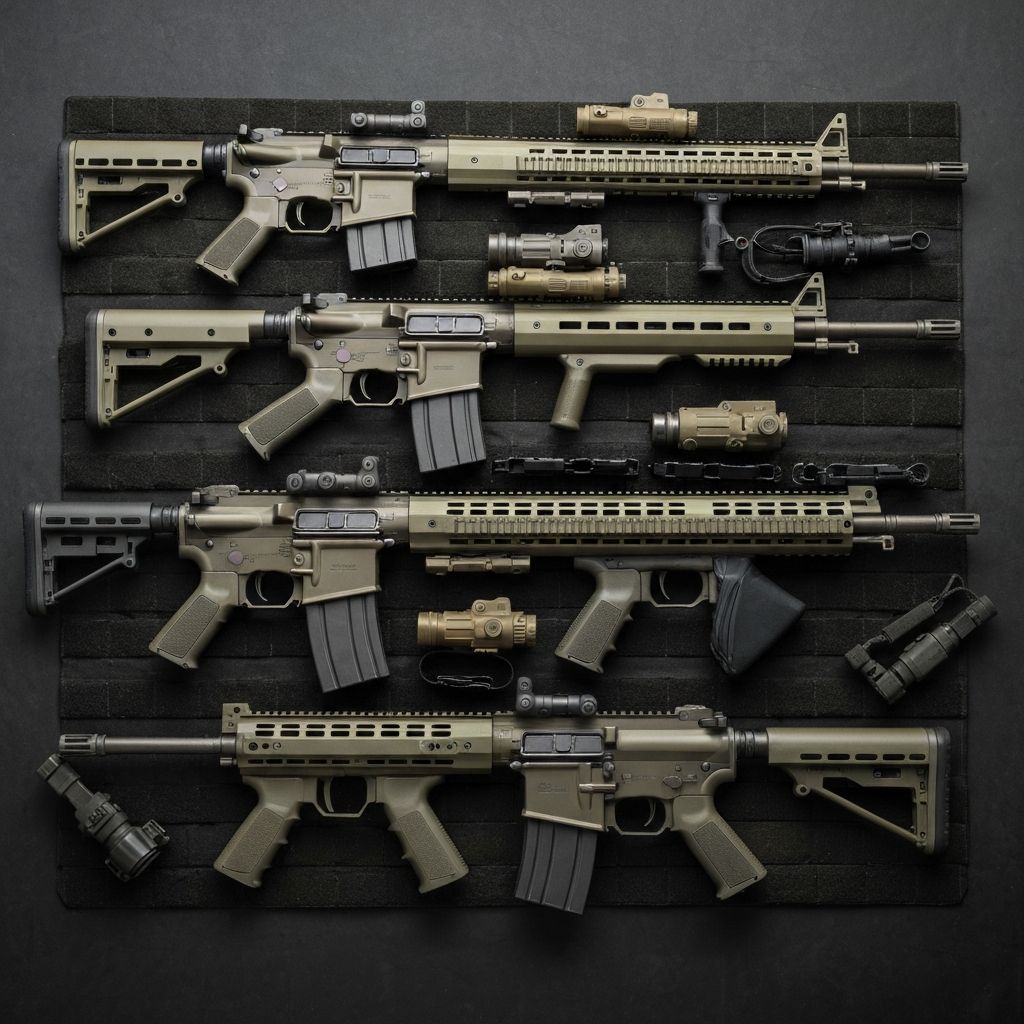
Automatic Electric Gun
The most common airsoft platform. Battery-powered motor drives a piston and spring mechanism, cycling BBs in semi-auto or full-auto.
Pros
- Most beginner-friendly platform
- Wide variety of guns, calibers, and styles
- No gas costs — just recharge the battery
- Generally reliable and consistent in all weather
- Huge aftermarket for upgrades and parts
- Most field rental fleets use AEGs
Cons
- Less realistic cycling feel than GBB
- Battery management required (charge, storage, care for LiPos)
- Very cheap AEGs have poor internals
- Some entry-level models require early upgrades
Best For
General skirmish, woodland, CQB, milsim support roles, beginners
Maintenance Level
Clean barrel with a silicone cloth regularly. Re-shim gears when needed. Keep hop-up rubber clean. Charge battery appropriately for LiPo vs NiMH.
Note: For most beginners, a mid-tier AEG from G&G, Specna Arms, ICS, or Tokyo Marui is the ideal starting point. Avoid sub-$80 "toy-grade" models — they are not built for field use.
Gas Blowback
Uses pressurized gas (typically green gas or CO₂) to fire BBs and cycle the bolt carrier or slide, providing realistic recoil and cycling.
Pros
- Highly realistic recoil and cycling action
- Magazine drop-free and authentic manipulation
- No wiring or battery required
- Excellent for enthusiasts and milsim players
- GBB rifles increasingly popular for their realism
Cons
- Performance drops in cold weather (gas pressure is temperature-sensitive)
- Ongoing gas costs
- More maintenance-intensive (O-rings, nozzles, gas routing)
- Magazine capacity often limited (realistic to source firearm)
- Higher learning curve for maintenance
Best For
Pistol side-arms, milsim primary weapons, enthusiast setups
Maintenance Level
Regular O-ring lubrication with silicone oil. Keep gas channels clear. Store magazines with a small amount of gas to keep seals lubricated. Do not use petroleum-based lubricants.
Note: GBB pistols are excellent as side-arms for any player. GBB rifles require more knowledge to maintain. Green gas is propane-based — CO₂ provides more consistent pressure but is harder on seals. Never use propane in a gun rated for green gas without a proper adapter and compatible seals.
Non-Blowback Gas
Gas-powered, but without the slide or bolt cycling mechanism. More gas-efficient and simpler, with no recoil simulation.
Pros
- More gas-efficient than GBB
- More consistent shot-to-shot (no gas used for cycling)
- Simpler internals — easier to maintain
- Less mechanical wear
Cons
- No recoil or cycling feel
- Less realistic
- Generally less popular for field use
- Fewer product options than AEG or GBB
Best For
Casual play, target practice, back-up sidearms, budget builds
Maintenance Level
Keep seals lubricated. Check nozzle O-rings. Standard gas gun care.
Note: NBBs are not commonly seen on skirmish fields as primary weapons. They work well as inexpensive practice tools or sidearms.
Spring-Powered
Manually cocked before each shot. A spring drives the piston. No batteries or gas required. Common for shotguns and sniper rifles.
Pros
- No batteries or gas needed
- Simple and reliable in any weather
- Very low maintenance
- Inexpensive entry point
- Sniper rifles are spring-powered by design
Cons
- Single-shot only — manual cock between each shot
- Not viable as a primary field weapon in most situations
- Low rate of fire limits CQB viability
- Cheap spring guns are often toy-grade
Best For
Sniper/DMR roles, backup guns, target practice, first-ever gun for kids
Maintenance Level
Keep spring and barrel clean. Minimal ongoing maintenance needed. Replace spring if power drops significantly.
Note: Spring-powered sniper rifles (VSR-10 platform, BAR-10, etc.) are a genuine play style. They require significant skill and field-appropriate engagement distances. They are not a beginner's shortcut — they demand more patience than any other style.
High-Pressure Air
Uses an external compressed air tank (carried in a rig or backpack) connected to the gun via a line. Highly consistent, adjustable, and customizable.
Pros
- Extremely consistent shot-to-shot performance
- Adjustable PSI for fine-tuned FPS control
- Does not degrade in cold weather (unlike green gas)
- Near-instant trigger response with some engines
- Popular in competitive and milsim play
Cons
- High upfront cost (engine + tank + regulator)
- Tank needs refilling at a paintball/dive shop
- Physical line from tank to gun (requires rig to hide it)
- Not beginner-friendly
- Some fields have additional HPA rules or restrictions
Best For
Competitive speedsoft, milsim primary weapons, advanced support gunners
Maintenance Level
Maintain the engine per manufacturer specs. Check tank, regulator, and line connections. Get the tank hydrostatically tested per regulations.
Note: HPA is not a beginner setup. It typically starts at $400+ for the engine and tank alone, before considering the gun. It offers the best consistency but requires significantly more knowledge to run.
BB Weights Explained
BB weight affects range, accuracy, wind drift, and energy on impact. Heavier BBs fly more consistently but require more power to reach the same velocity.
| Weight | Typical Use | Notes |
|---|---|---|
| 0.12g | Toy-grade / practice | Do not use in field guns — fragile, can shatter |
| 0.20g | Entry-level AEG | Standard baseline weight; less accurate in wind |
| 0.25g | General skirmish | Recommended upgrade for most AEGs |
| 0.28g | CQB / outdoor AEG | Good balance for most setups |
| 0.30g | Precision / DMR | Better long-range consistency with tuned hop |
| 0.32–0.36g | Sniper / DMR | Requires appropriate power and hop-up |
| 0.40g+ | Sniper class only | Very heavy; requires high-power sniper setup |
Hop-Up Explained
The hop-up (Hop-Up Chamber) is one of the most important components in your gun. It applies backspin to the BB as it exits the barrel, using a rubber nub pressing against the BB in the air passage. This backspin creates lift via the Magnus effect, allowing the BB to fly flatter over greater distances.
Tuning Your Hop-Up